


On 2 August 2026, a law took full effect in Europe that companies had been preparing for over two years. Five days beforehand, the EU had amended it once again.
Anyone who has been following the news coverage over the last few weeks is probably confused. And rightly so. We’ll sort things out and answer the question that matters most to you: Does the EU AI Act also affect Switzerland, if your company is based here?
What the EU AI Act is
The EU AI Regulation is the world’s first comprehensive set of rules for artificial intelligence. It has been in force since August 2024, but applies in stages. The basic principle is simple: the greater the risk posed by an application, the stricter the obligations.
A spam filter falls into the lowest category. A system that assesses creditworthiness or evaluates job applications is considered high-risk. And some applications are completely prohibited, such as social scoring or mass biometric surveillance.
What actually happened on 2 August 2026
From a legal point of view, the term ‘entry into force’ is misleading in this context. The regulation has been in force for two years. What began on Sunday is its general application, and with it, above all, its enforceability by the authorities.
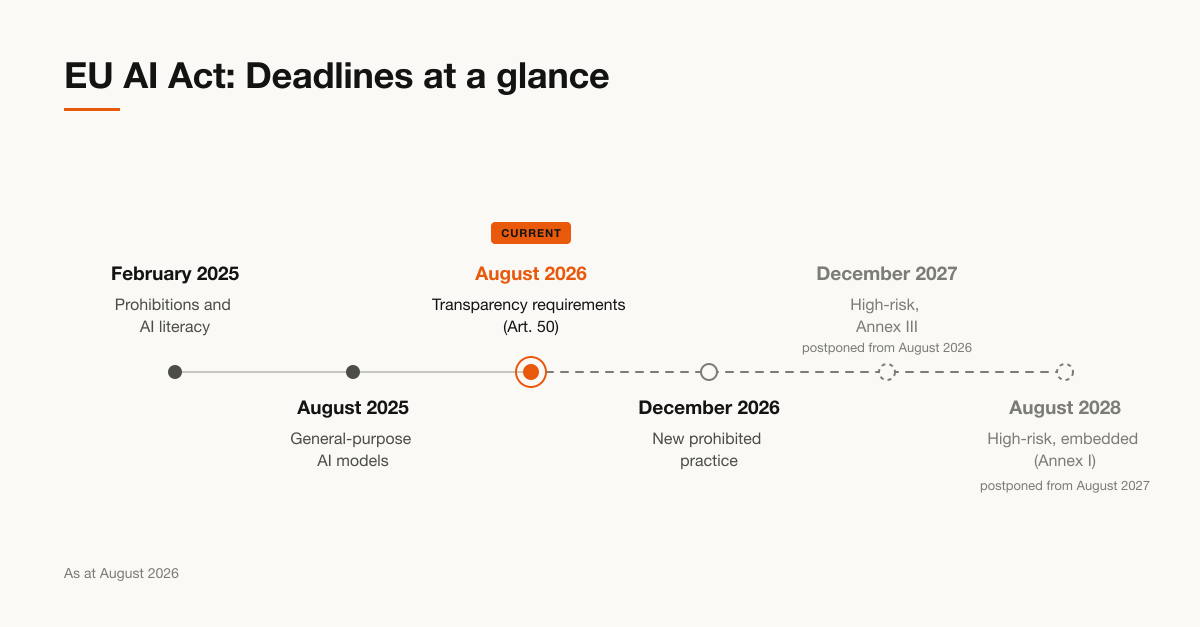
Prior to that date, two levels were already in place:
- From February 2025, bans on certain practices and the obligation to train staff in the use of AI
- From August 2025: the obligations for providers of general-purpose AI models
What the EU postponed at the eleventh hour
On 24 July 2026, the so-called Digital Omnibus Regulation on AI was published in the Official Journal of the EU and came into force three days later. It significantly postpones the most onerous obligations:
| Obligation | Previously | New |
|---|---|---|
| Standalone high-risk systems (Annex III) | 2 August 2026 | 2 December 2027 |
| Embedded high-risk systems (Annex I) | 2 August 2027 | 2 August 2028 |
| Transparency requirements (Article 50) | 2 August 2026 | unchanged |
The reason is pragmatic. The technical standards and the relevant authorities were simply not ready in time. So the obligations are not being waived; they will come into force later.
An overview of the progress of implementation in the individual countries is provided by the Overview of national implementation plans.
What currently applies and affects most businesses
The transparency requirements under Article 50 have not been postponed. They have been in force since 2 August 2026. And it is precisely these requirements that affect a great many companies, without them even realising it:
Chatbots must be identifiable. Anyone who runs an AI-powered chat service on their website must make it clear to visitors that they are not speaking to a human being.
AI-generated content must be labelled. This applies to images, audio and video, and, under certain conditions, to text as well.
Deepfakes must be disclosed. In other words, content that depicts real people or events in a deceptively realistic manner.
In addition, a new prohibited practice will come into force on 2 December 2026: AI systems that generate intimate images of real people without their consent.
The fines are substantial. For prohibited practices, they can be up to 35 million euros or seven per cent of global annual turnover; for breaches of high-risk obligations, up to 15 million euros or three per cent.
Does the EU AI Act apply in Switzerland?
Switzerland does not have an AI law. In February 2025, the Federal Council deliberately decided against introducing a comprehensive set of its own regulations. Instead, the Council of Europe’s AI Convention is to be ratified and existing legislation adapted where necessary. A draft bill for consultation is to be drawn up by the end of 2026.
The official position on this is maintained by the Federal Office of Communications. A well-maintained overview of political developments is also provided by AlgorithmWatch CH.
That sounds reassuring. But only up to a point.
This is because the AI Act extends beyond the EU’s borders. What matters is not where a company is based, but where the outputs of an AI system are used. A Swiss company is therefore covered if it:
- sells an AI-powered product to customers in the EU
- operates a website that is clearly aimed at EU customers
- supplies subsidiaries in the EU with AI applications
For a craft business with a purely regional customer base, little will change at first. For anyone with cross-border business, it’s worth taking a closer look.
Liechtenstein: A special case
Liechtenstein is part of the European Economic Area. Once the AI Act has been incorporated into the EEA Agreement, it will apply directly there, just as it does in the EU. This process is currently underway.
The initiative Digital Liechtenstein pointed out early on that the same rules would apply in the Principality as in the EU.
For businesses in the Principality, this means that the question is not ‘if’, but ‘when’. And the market location principle already applies today, as soon as business extends into the EU.
What you can do specifically right now
You don’t need a compliance department. But there are four steps that are well worth taking:
1. Get an overview. Where in your company is AI being used? Most people underestimate this. Translation tools, text assistants, image generators, chatbots, recruitment software. A lot of it is already in use without ever having been consciously introduced.
2. Clarify your role. Do you develop AI systems, or do you use third-party ones? The obligations differ considerably. Most businesses are deployers, not providers.
3. Check your website. Is there a chatbot running? Is it clearly labelled as such? Do you use AI-generated images? These are the points that have applied since Sunday. We’d be happy to review your website as part of our Website maintenance arrive.
4. Train your team. The requirement for AI literacy has been in force since February 2025, yet it is often overlooked. It does not require any certificates, but rather a basic understanding of what the tools used do and where their limitations lie.
A word from us
At Swiss Media Design, we use AI ourselves: for research, for drafts and for distributing posts across our channels. This text was created with the help of an AI system, and has been edited and approved by a human.
We are not writing this out of a sense of duty, but because transparency is the very least one should expect in this instance. Anyone who writes about labelling requirements should label their own content too.
Conclusion
2 August 2026 was no earthquake, but it was not a non-event either. The major obligations for high-risk systems have been postponed until the end of 2027. What now applies are the transparency rules, and these affect far more companies than many realise.
For Swiss firms with no business in the EU, there is no immediate need for action. For all others, the following applies: carrying out this assessment takes an afternoon. Having to do it later will cost more.
Are you unsure whether your website is affected? Get in touch with us, we’ll have a look at it together.
Common questions
Does the EU AI Act apply to Swiss companies?
Not directly, but via the market location principle. The decisive factor is where the results of an AI system are used. Swiss companies with customers, products or subsidiaries in the EU are covered.
What applies as of 2 August 2026?
The general applicability of the Regulation and, consequently, its enforceability by the authorities. Specifically, the transparency requirements set out in Article 50 apply to most businesses: chatbots must be identifiable, and AI-generated content must be labelled.
What has the Digital Omnibus postponed?
Obligations for high-risk AI systems. Stand-alone systems from 2 December 2027; systems embedded in products from 2 August 2028. The transparency obligations remain unchanged.
Does Switzerland have its own AI law?
No. The Federal Council has decided to ratify the Council of Europe Convention and to make selective amendments to existing legislation. A consultation draft is due to be presented by the end of 2026.
Does the Act apply in Liechtenstein?
Liechtenstein is part of the EEA. Once incorporated into the EEA Agreement, the Regulation will be directly applicable there. This process is currently underway. The market location principle already applies today.
How much are the fines?
For prohibited practices, fines of up to 35 million euros or seven per cent of global annual turnover. For breaches of high-risk obligations, fines of up to 15 million euros or three per cent.
Sources
- Regulation (EU) 2024/1689 at a glance (AI Regulation with full text and explanatory notes)
- National Implementation Plans (implementation status by country)
- BAKOM: Artificial Intelligence (official status of Swiss regulation)
- Digital Switzerland: Action Plan (federal measures)
- AlgorithmWatch CH: Guide to AI Regulation (political timeline)
- Digital Liechtenstein on the EU AI Act (assessment for the Principality)
As at 7 August 2026. This article is for general information purposes only and is not a substitute for legal advice. If you have specific questions regarding how this may affect your business, please consult a specialist.